
Hong Kong Swimming Competition - Complete Guide to Long and Short Pools for Toddlers and Teenagers 2025

Today we've compiled a complete guide to Hong Kong swimming competitions – long and short courses for children and teenagers, 2025.
These experiences are what my daughter and I gained from learning to swim in K2 to primary school, and I hope to compile the most useful information for other families on the same swimming journey.
2025 SEEDINO New Project - Hong Kong's First Swimming Learning Cradle
Today's competition sharing is mainly aimed at kindergarten and primary school children, covering a complete guide to swimming competitions for children aged 4 to 12. The content is divided into three parts:
- Swimming Federation (Professional Level) Competition
- Long Course (Amateur Level) Competition
- Short course (incentive-based) competition
Since there are many details to share about the Swimming Federation's competitions, I will write a separate article in the future, as the Swimming Federation's families and young athletes should be somewhat familiar with the rules.
Today's focus is on sharing the differences between long-course competitions (relative to amateur levels) and short-course competitions (relative to incentive-based competitions). You can choose to participate based on your needs. I've created a separate A4 chart detailing each competition category at the end of the article for your convenience in saving and sharing.
Extended Reading: Hong Kong Swimming Competitions - Hong Kong Swimming Association: Comprehensive Guide to D1/D2/D3 Events, In-depth Analysis of Classification Rules, Advancement Mechanisms and Competition System
You might ask, why are toddlers divided into long and short courses? In the adult world, long and short courses aren't divided this way. The main reason is that toddlers' stamina isn't necessarily as strong, and the experience of swimming 25 meters and 50 meters is completely different compared to adults. For toddlers, 50 meters isn't a distance that everyone can easily complete.
Due to the limited content I can share, I have only listed the children's competitions that are of most importance to parents.
In the market, every swimming club holds various large and small water sports events every year to allow athletes to experience the spirit of sports, including: Bondi Swim - Pokémon, Stanford - Transformers Swimming Challenge, Dali Swim Club - Ultra-Short Distance Flying Fish, Alex Fong - Mini Water Sports Event, etc.
In fact, observing a swimming club's competitions can give you a general idea of the average level of its coaches. For children aged 4 to 6, if they want to participate in long-course competitions (amateur level), there are also some emerging young swimming brands whose children are already capable of challenging the FA Swimming Association's D3 competitions (winning level).
Generally speaking, short-course competitions (which are incentive-based) are the healthiest option. As can be seen from Coach Zhong Yuan's U-series in the picture, group competitions also have rankings and medals, implementing comprehensive and incentive-based competitions that benefit everyone.
Athletes who can participate in the Swimming Federation's competitions (professional level) are naturally the most professional and representative in the industry. Even well-known top universities will select students based on the Swimming Federation's results.
Ting Shen Reading: Swimming is about learning to face failure, not arrogance and victory. Alex Fong: "My swimming club teaches you how to lose and how to face failure."
Therefore, the quality of a swimming club can be judged by the competitions it participates in. For example, if 7-year-olds from Swimming Club A participate in the 50-meter race of the World Swimming Federation's D3 level, while 7-year-olds from Swimming Club B participate in the 25-meter race of the U-series level, you can quickly tell which club has better coaches. I believe smart parents will understand what I mean (this is an objective discussion).
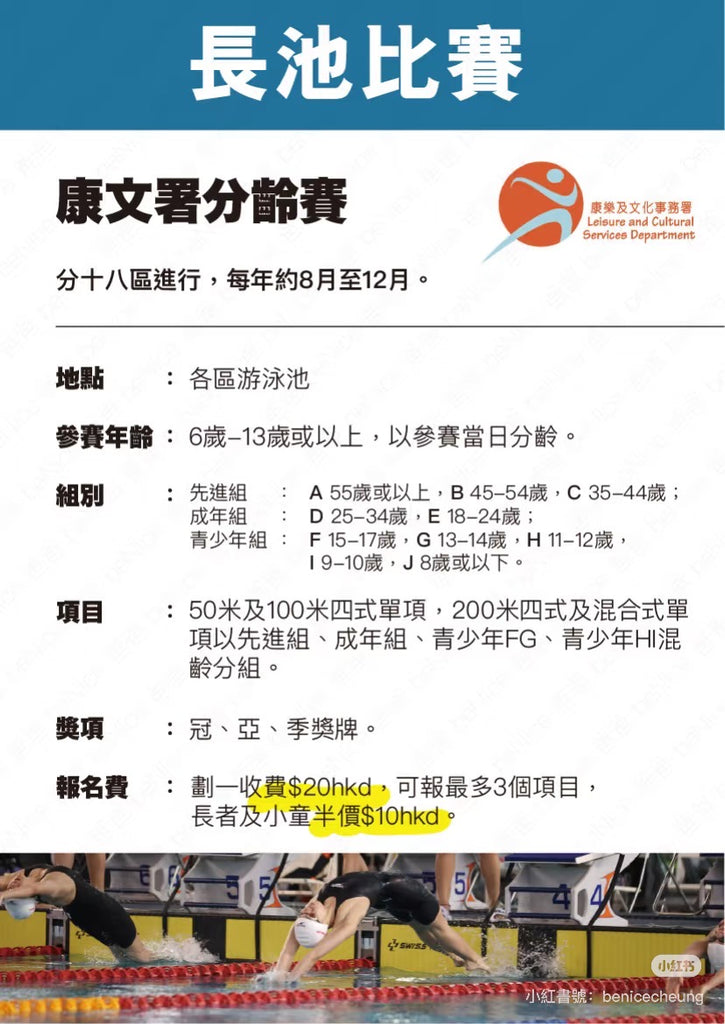


Due to space limitations, I cannot list all the information. If you have information on other swimming competitions for young children and teenagers, please leave a message so I can update the list and provide parents with more comprehensive information.
That's all for today's sharing. Feel free to email me with any questions or comments . See you next time, bye-bye!
Benice Cheung